
GST on Restaurant Bills in India: Rates, CGST and SGST, and What a Bill Must Show
The GST rate on restaurant food, why bills show CGST and SGST, what a GST bill must include, and how delivery app orders are taxed. Updated for 2026.
Every restaurant, café and cloud kitchen in India that is registered for GST has to get three things right on every bill: the rate, the split between CGST and SGST, and the details the bill must carry. This guide explains each one in plain language, with a worked example you can check your own bills against. Every rule is linked to its source at the end.
The GST rate on restaurant food
For most food businesses the answer is simple: 5% GST, without input tax credit (ITC).1 That covers standalone restaurants, cafés, dhabas, cloud kitchens, takeaway counters and home kitchens, whether the guest eats in, takes away or has the food delivered.
The exception is a restaurant inside a hotel that charges more than ₹7,500 a night for a room. GST calls such a hotel a "specified premises", and food served there is taxed at 18%, with input tax credit.2 Whether a hotel counts is decided by its room rates in the previous financial year, so ask your accountant if your restaurant is part of a hotel.
| Where the food is served | GST rate | Input tax credit |
|---|---|---|
| Standalone restaurant, café, dhaba or bar's food service | 5% | Not allowed |
| Cloud kitchen, takeaway or delivery-only kitchen | 5% | Not allowed |
| Restaurant in a hotel with room tariffs above ₹7,500 a night | 18% | Allowed |
"Without input tax credit" means you can't reduce the GST you pay by the GST you were charged on ingredients, rent or equipment. The 5% you collect from guests is the 5% you pay.
It wasn't always this simple. Until November 2017, a standalone restaurant's rate depended on whether it had air conditioning or served liquor. The GST Council replaced both rates with a single 5% from 15 November 2017.1
Source: GST Council, 23rd meeting (via TaxGuru) (opens in a new tab)
Why the bill shows CGST and SGST, not IGST
GST on a sale inside one state is split equally between the central government (CGST) and the state (SGST). For a restaurant, the place of supply is where the food is served or handed over, which is always your own state. So the 5% always appears as CGST 2.5% + SGST 2.5%, never as IGST, even if the guest is visiting from another state. In a union territory without its own legislature, SGST is replaced by UTGST, at the same rate.
A worked example
A table orders paneer tikka, dal makhani and two butter naans:
| Item | Amount |
|---|---|
| Paneer Tikka | ₹280.00 |
| Dal Makhani | ₹260.00 |
| Butter Naan × 2 | ₹120.00 |
| Subtotal (taxable value) | ₹660.00 |
| CGST @ 2.5% | ₹16.50 |
| SGST @ 2.5% | ₹16.50 |
| Total | ₹693.00 |
GST is worked out on the value after any discount. If the table used a coupon for ₹60 off, the taxable value would be ₹600, each tax ₹15.00, and the total ₹630.00.
The rate makes a real difference to what the guest pays. Here is the same ₹660 meal at both rates:
Worked out from the rates above; the hotel bill carries ₹85.80 more tax.
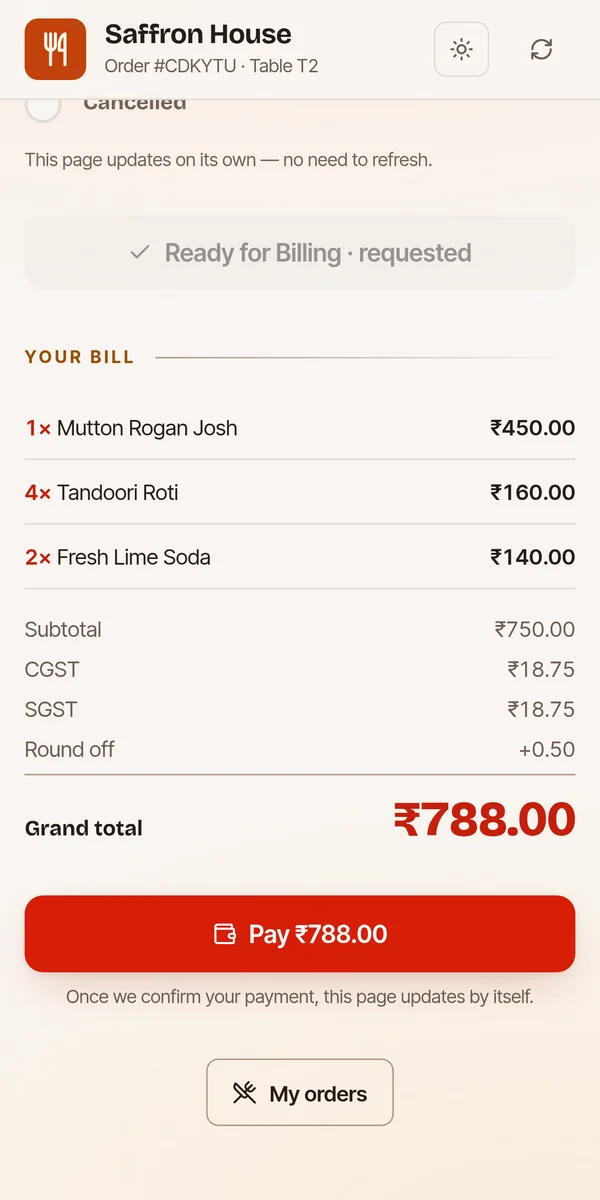
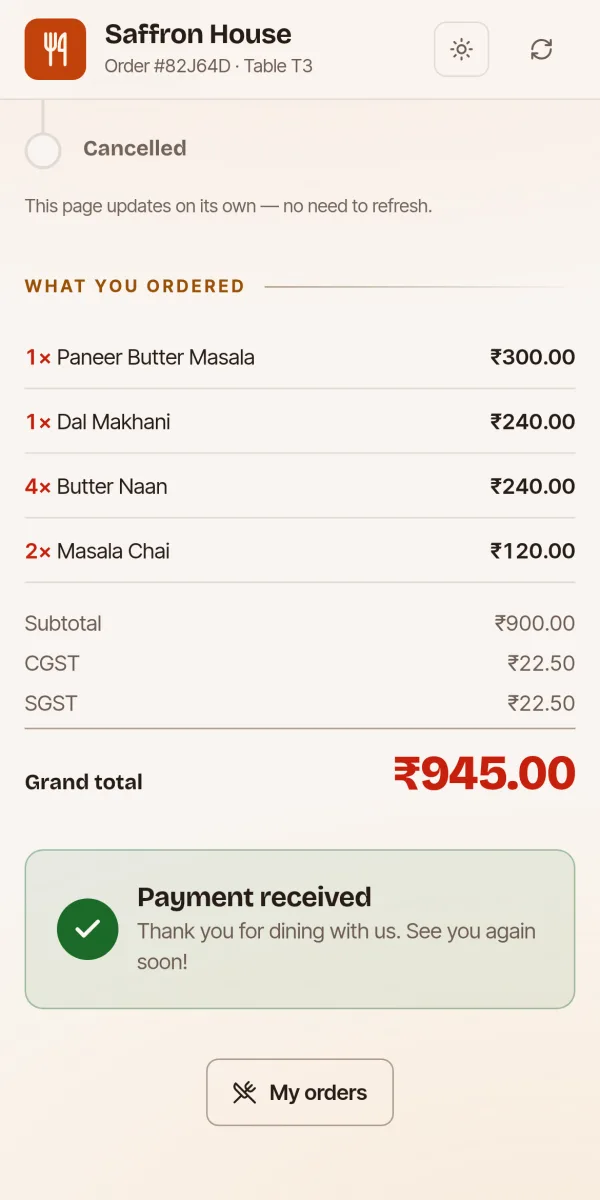
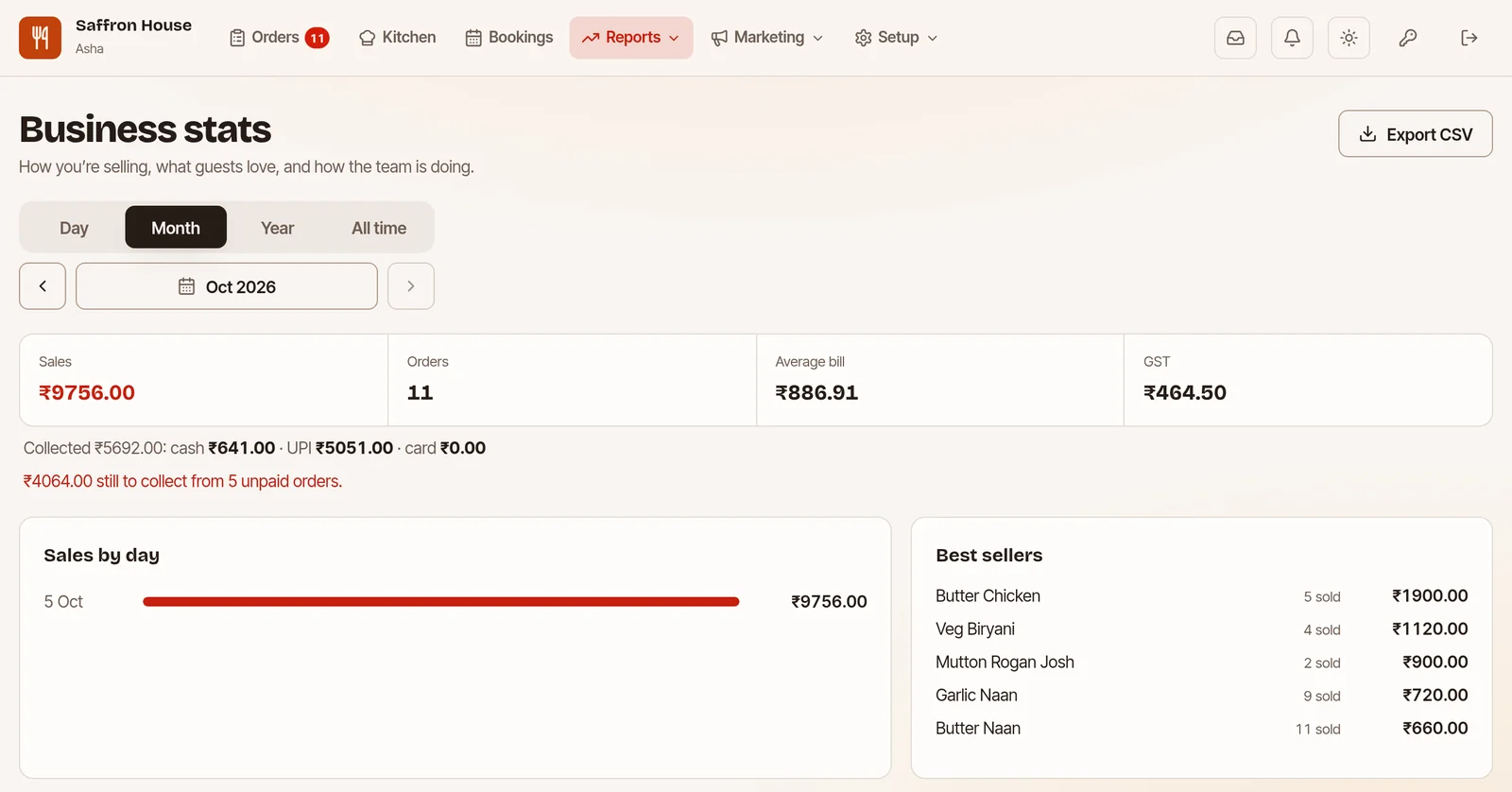
This is what the same arithmetic looks like on a real bill. Both screens are from Dineto, on a sample restaurant:
What a GST bill must show
A tax invoice from a GST-registered business has to carry the details set out in Rule 46 of the CGST Rules.3 For a restaurant bill to a walk-in guest, check that yours shows:
- Your business name, address and GSTIN.
- An invoice number that runs in sequence, is unique for the financial year, and is no longer than 16 characters. Gaps and repeats are what auditors look for first.
- The date of the bill.
- Each item, with its quantity and value.
- The taxable value, after any discount.
- The rate and amount of CGST and SGST, shown separately.
- The total amount.
The service accounting code (SAC) for restaurant services is 996331, and many restaurants print it on the bill. If a guest asks for a GST bill in their business's name, add their name, address and GSTIN.
Composition scheme: when you can't charge GST at all
A small restaurant can choose the GST composition scheme if its turnover is within the limit (₹1.5 crore in most states).4 Under it you pay GST as a flat 5% of turnover and file simpler returns, but you can't collect GST from guests. Instead of a tax invoice you issue a "bill of supply", which must say you are a composition taxable person. If you're on the composition scheme, a bill showing CGST and SGST is wrong.
Orders through food delivery apps
Since 1 January 2022, the food delivery app collects and pays the 5% GST on restaurant orders placed through it, under Section 9(5) of the CGST Act.5 The CBIC's clarification also confirms that the app, not the restaurant, issues the tax invoice for those orders.6 You don't charge GST again on them, and the app's statements show the tax it paid.
- Order on a delivery appThe app charges the guest 5% GST and pays it to the government
- Order on your own link, phone or tableYou charge 5% (CGST + SGST) on your own bill
- In your booksKeep the two apart, so no sale is taxed twice or missed
Orders that come to you directly, on your own website, by phone, on WhatsApp or at the table, are your sales: you charge the 5% and pay it in your own returns.
Service charge and packing charges
Under guidelines issued by the Central Consumer Protection Authority in July 2022, a restaurant can't add a service charge to the bill automatically or by default, or collect it under another name.7 The Delhi High Court upheld those guidelines on 28 March 2025.8 If a guest chooses to pay one, GST applies to it as part of the bill.
Packing and delivery charges you add to a takeaway or delivery order are part of the same supply as the food, so they generally take the same 5% rate.
Do you need to register for GST?
Food businesses supply a service, so registration becomes compulsory once your turnover in a financial year crosses ₹20 lakh (₹10 lakh in some special category states). Selling through food delivery apps brings its own registration requirements, which the apps will ask about when you sign up, so check with your accountant before you list. You register on the GST portal.9
Mistakes we see most often
- Charging 18% because "AC restaurants pay more". That rule ended on 15 November 2017; a standalone restaurant charges 5% with or without air conditioning.1
- Showing IGST on a bill to a guest from another state. Restaurant bills are always CGST + SGST.
- Invoice numbers that restart every day, skip, or repeat across two counters.
- Working out GST on the price before a discount instead of after it.
- Charging GST again on orders the delivery app has already taxed.
- Adding a service charge to every bill by default.7
Getting it right without a calculator
Billing software should do all of this for you: apply the right rate, split it into CGST and SGST, take discounts off before tax, and number every bill in an unbroken sequence. In Dineto, every bill is worked out this way, carries a UPI QR code for the exact amount, and can be printed on a thermal printer or sent to the guest's WhatsApp as a PDF. The GST collected each month is in your reports, ready for your accountant.
If you're still writing kitchen orders by hand, read our guide on what a KOT is and how it keeps orders and bills in step.
Sources
We check every figure in this guide against these sources. Rules change, so the date of each is given.
- GST rate on restaurant services: 5% without ITC, decisions of the 23rd GST Council meeting (opens in a new tab)GST Council, 10 November 2017 (reproduced by TaxGuru) · taxguru.in
- GST rate changes for hotels and restaurants from 22 September 2025 (opens in a new tab)TaxGuru, September 2025 · taxguru.in
- Rule 46 of the CGST Rules, 2017: tax invoice (opens in a new tab)CGST Rules, Chapter VI (reproduced by ClearTax) · cleartax.in
- Composition scheme for restaurants: limit, rate and bill of supply (opens in a new tab)Enterslice · enterslice.com
- Notification No. 17/2021-Central Tax (Rate): restaurant services through e-commerce operators (opens in a new tab)CBIC, 18 November 2021 (reproduced by TaxGuru) · taxguru.in
- Circular No. 167/23/2021-GST: restaurant services supplied through e-commerce operators (opens in a new tab)CBIC, 17 December 2021 · gstcouncil.gov.in
- No hotel or restaurant can add service charge automatically or by default in the food bill (opens in a new tab)Ministry of Consumer Affairs (PIB), 4 July 2022 · pib.gov.in
- Service charge on restaurant bills is not mandatory: Delhi High Court (opens in a new tab)LiveLaw, March 2025 · livelaw.in
- GST registration (opens in a new tab)Goods and Services Tax Network · gst.gov.in