
What Is a KOT (Kitchen Order Ticket)? How It Works in a Restaurant
What a KOT is, what it should show, how it differs from the bill, and how numbered kitchen tickets stop lost orders and missing money.
A KOT, or kitchen order ticket, is the instruction that tells the kitchen what to cook. When a waiter takes an order, a guest orders from a table QR code, or a delivery order comes in, a KOT is what carries that order from the front of the house to the stove. It's one of the smallest pieces of paper in a restaurant, and one of the most important.
- Order takenAt the table, on a QR code, by phone or online
- KOT madeA numbered ticket with the dishes, the table and the time
- Kitchen cooksFrom the ticket, oldest first
- ReadyThe floor sees it's ready without asking
- BilledThe bill is built from the same order, so nothing is missed
What a KOT is for
Without a KOT, orders reach the kitchen as a shout across the pass, a scribble on a pad, or a phone message the cook has to scroll back to find. That works on a quiet afternoon. On a Friday night it is where orders get lost, dishes go to the wrong table, and food leaves the kitchen without ever being billed.
A KOT fixes that in three ways:
- The kitchen cooks from one source. Every dish it makes was asked for on a ticket, so nothing is cooked from memory.
- Every order has a number. When a guest asks where their food is, staff can find the ticket instead of asking the cook.
- What was cooked can be matched to what was billed. At the end of the night, every KOT should end up on a bill. A KOT with no bill is food that went out unpaid.
What a KOT should show
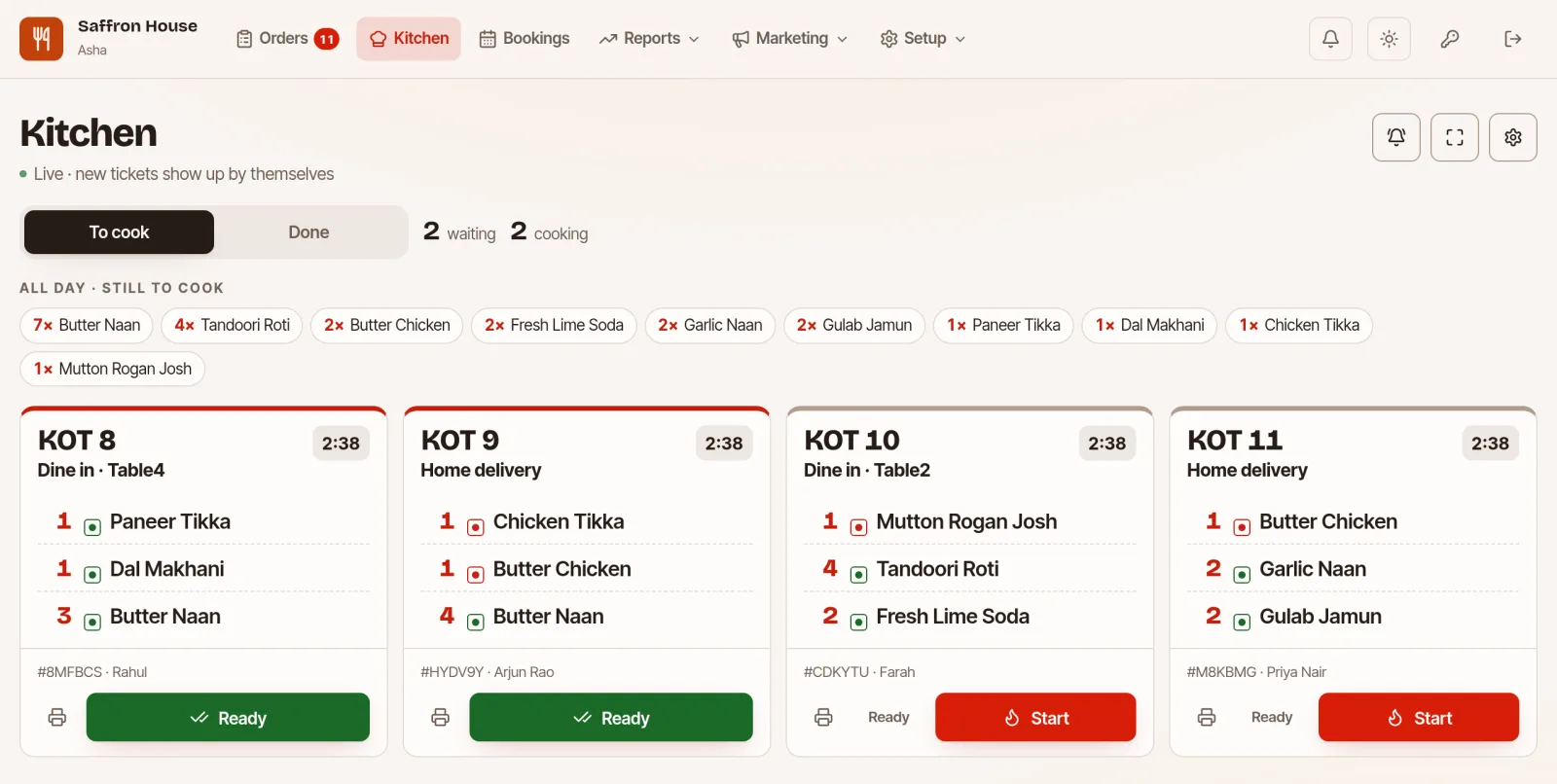
A good KOT is quick to read from a metre away in a hot kitchen. It usually carries:
- A KOT number, in sequence for the day.
- Where the order is going: a table number, takeaway, or delivery.
- The time it was placed, so the oldest ticket is cooked first.
- Each dish and its quantity, in large type.
- The option chosen, such as half or full, or veg, egg or chicken.
- Notes from the guest: less spicy, no onion, Jain.
- Who took the order.
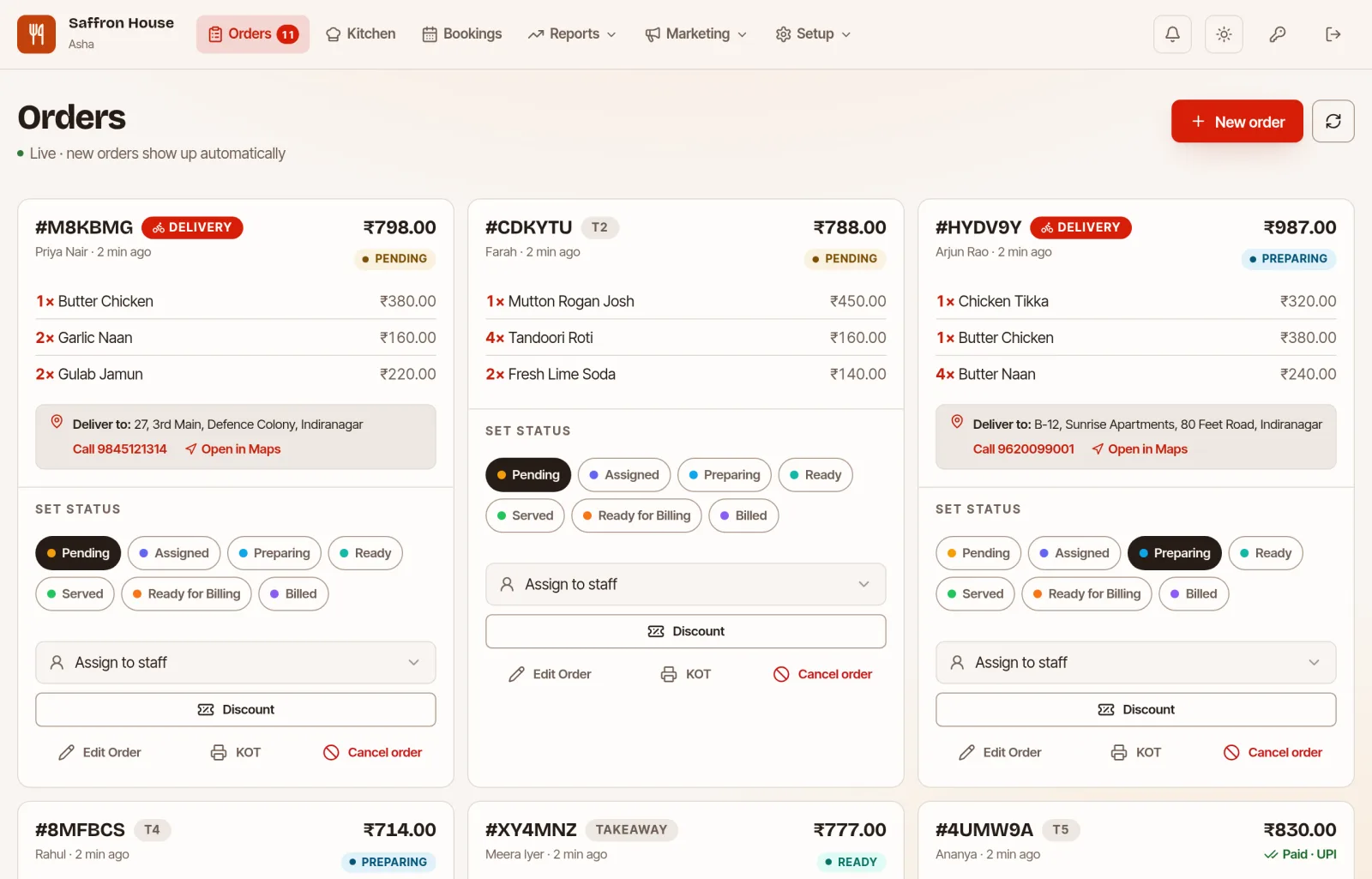
Prices are usually left off. The kitchen needs to know what to cook, not what it costs. Here is what that looks like on a kitchen screen:
KOT vs bill: what's the difference?
The KOT goes to the kitchen; the bill goes to the guest. A table that orders three times during a meal gets three KOTs, one for each round, but one bill at the end with everything on it.
| KOT | Bill | |
|---|---|---|
| Who it's for | The kitchen | The guest |
| When it's made | Each time something is ordered | Once, when the guest is ready to pay |
| What it shows | Dishes, quantities, notes, table | Dishes, prices, GST, total |
| How many per table | One per round of ordering | Usually one |
| Numbering | In sequence for the day | In sequence for the financial year, by law1 |
Because the bill is built from the KOTs, a system that links them means the bill is already correct when the guest asks for it. Nobody has to add it up from memory or from a stack of slips. If you want to know what that bill must show, see our guide to GST on restaurant bills.
Additions and cancellations
The trickiest moments are when a table adds a dish after the first order, or cancels one. Both should get their own ticket:
- An addition KOT tells the kitchen to cook one more thing for a table that is already eating, without re-sending the whole order.
- A cancellation KOT tells the kitchen to stop, so the dish isn't cooked and wasted, and takes it off the bill.
Paper KOTs or a kitchen screen?
Printed KOTs come out of a thermal printer in the kitchen, usually 58 mm or 80 mm wide. They are cheap, cooks are used to them, and they work even when the kitchen is noisy and greasy. The downside is that paper gets lost, splashed or spiked on the wrong rail.
A kitchen display (KDS) shows tickets on a screen or tablet by the stove instead. The cook taps a ticket to start it and again when it's ready, so the floor staff can see what's ready without walking into the kitchen. Nothing gets lost, and the oldest order is always at the top.
| Printed KOT | Kitchen screen | |
|---|---|---|
| Cost to start | A thermal printer | A tablet or screen you may already own |
| Lost or splashed tickets | Happens | Can't happen |
| Floor knows when food is ready | Someone has to walk in and ask | Shows as soon as the cook taps Ready |
| Travels with a delivery bag | Yes | Print one when you need it |
Many kitchens use both: a screen for the line, and a printer for the tickets that need to travel with the food, such as delivery bags.
Good KOT habits
- Number every ticket, and never reuse a number in the same day.
- Send the order to the kitchen the moment it's taken, not after the waiter has finished the round.
- Put guest notes on the ticket, not in the waiter's head.
- Give additions and cancellations their own tickets, never a pen mark on the old one.
- At closing, check that every KOT ended up on a bill.
KOTs in Dineto
In Dineto, every order becomes a numbered KOT automatically, whether it came from a table QR code, a staff member's phone, your ordering website or a phone call. Tickets show on a kitchen screen, print on 58 mm or 80 mm thermal printers, or both. Additions and cancellations each get their own ticket, the cook marks each order as cooking and then ready, and the bill is built from the same order, so what was cooked and what was billed always match.
Running a delivery-only kitchen? Read how to start a cloud kitchen in India.
Sources
We check every figure in this guide against these sources. Rules change, so the date of each is given.
- Rule 46 of the CGST Rules, 2017: tax invoice (consecutive serial numbers, unique for a financial year) (opens in a new tab)CGST Rules, Chapter VI (reproduced by ClearTax) · cleartax.in